Discussions
of the Applications and Relevance of a Greenhouse Fogging System
Description:
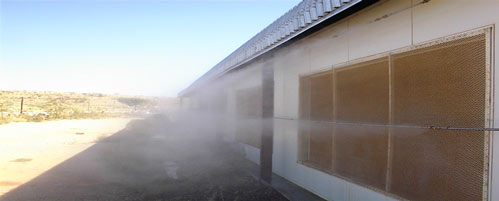
A fogging system uses moderately high water pressure (60 Bar) and
custom nozzle design to produce an ultra fine mist (fog) with droplet
sizes of approximately 10 microns. A high pressure pump pressurizes
water through stainless steel tubes and anti-drip check valves/swivel
nozzles. It is designed and pre-assembled as per specified requirements
for humidity and/or temperature control, as well as, accounting for
existing ventilation systems. The system is completely adaptable to
any greenhouse design.
Rationale
The single most significant issue in greenhouse production is 'plant
water stress'. This is typically induced by drought or extreme evaporative
demand to which the plant's plumbing system cannot respond and the
result is a wilted plant. However, there are a number of factors which
affect a plant's 'water status' and ultimately, its overall health
and productivity. These include environmental parameters such as temperature,
humidity, light quality and carbon dioxide concentration as well as
soil nutrient and moisture availability. Let us assume that the soil
environment is a healthy one and concentrate our attention on the
aerial environment.
A plant's connection to the air is via tiny pores in the leaves called
stomata. Almost all the water loss from a plant occurs through evaporation
from these opening. As well, most of the carbon required for growth
is taken up in the form of carbon dioxide through the stomata pores.
The size of the stomata opening, and thus their operating efficiency,
is under the control of the plants water status. A plant experiencing
no water stress or drought will have fully turgid leaves with wide
open stomata. Carbon dioxide exchange will be optimized and given
appropriate light and temperature requirements, the plant's productivity
will, in turn, be optimum.
However, it is not enough to simply give plants plenty of water. The
stomata are sensitive to humidity, temperature, light and carbon dioxide
and any one of these factors should they become limiting, could exhibit
feedback control over the pant's water status. Obviously, ideal growth
conditions are those which optimize all of the above parameters.
The greenhouse provides a unique and simple system of environmental
control. However, the corollary to environmental control is that we
must provide the systems to maintain an appropriate balance in environmental
factors. These systems may be necessarily elaborate and expensive
and cost effectiveness is of prime importance when considering greenhouse
management. This brings us to a consideration of the Fogging System.
Does it effectively address the concerns of efficient and economical
environmental control in the greenhouse?
Bearing in mind the key environmental factors discussed above, let
us consider a greenhouse installation in its simplest possible form…a
glass or plastic enclosed space into which we place crop. As soon
as the sun comes out we quickly realize the need for ventilation as
the temperature riser. In temperate climates such as ours the lethal
temperature for most plants is around 45 degrees C. This can easily
be exceeded in an unventilated space as we can all demonstrate by
leaving windows up in our car on even a moderate summer day. The response
of plants to elevated, but still sub-lethal, temperatures is to close
their stomata and essentially stop doing business with the environment.
Along with high temperatures come low humidity in a greenhouse. The
humidity difference between the air and the plant surface (meaning
the stomata pore) is the driving force for water loss from the plant.
As the air gets drier it pulls harder on the plant's moisture. Up
to a point this is fine since the plant uses their transpiration stream
to draw nutrients from the soil and distribute them. However, the
plumbing system has a limit and when the demand for water in the air
exceeds that limit the plant again responds by closing the stomata,
turning off the tap. The stomata act as a very effective safety valves
but their other main function is to allow carbon dioxide into the
leaves to be used in photosynthesis. This function is lost every time
they close up to stave off water stress.
Before we leave this discussion of plant-atmosphere interaction we
should add the role of light. Light provides the energy for the plants
to utilize carbon dioxide in primary production (photo-synthesis).
The quality and quantity of light are important variables which will
ultimately be reflected in the production and quantity of the crop.
In the greenhouse environment, however, light also influences the
temperature component. During certain parts of the year most greenhouse
operations find it necessary to shade the crop by whitewashing the
glass or erecting blinds. This is done when the ventilation system
can not cope with the increased heat load. Unfortunately, this may
also reduce the quality of the light reaching the crop.
Enter the Fogging System… injecting a suspended cloud of water particles
into the greenhouse environment will have several concurrent beneficial
effects. These include:
- Evaporative
cooling of the air. As each gram of water evaporates it will extract
540 calories of heat from the air. This cool air is denser and will
therefore fall and contribute to convection currents ventilating
the crop and facilitating efficient gas exchange (carbon dioxide).
- Humidification,
the evaporating water will contribute to the humidity of the air
around the crop and decrease the demand for water from the leaves.
This, in turn, will allow it to perform nearer optimum efficiency.
- Maintenance
of increased light levels and quality. The need to provide shading
will be reduced except under extreme conditions. The fog will provide
some radiation screening and the evaporative cooling will help maintain
favorable temperature.
In contrast
to the pad and fan, the Resulting from the above conditions will be
a crop that rarely experience environmental conditions which induce
water stress and therefore is always making the best use of available
resources. The points of connection between the crop and the atmosphere,
the stomata, are not permitted to experience adverse temperature,
humidity or light levels and thus stay open for the longest possible
time to take up carbon dioxide.
Fog versus
Conventional Alternatives.
The most common conventional humidification system is the 'pad and
fan" method. This employs a fan to bow air over a water saturated
pad and into the greenhouse environment. There are a number of variations
on this approach but they are all limited in one basic way…they can
produce large humidity (and thus temperature) gradients across the
greenhouse. The air is wettest near the pad and loses moisture as
it transverses the greenhouse. This effect can be mitigated by increasing
the number and distribution of pads and fans but the operating cost
becomes limiting.
In contrast to the pad and fan, the fogging systems provides even
distribution of humidity and temperatures throughout the greenhouse.
It creates and utilizes natural convection currents to promote environmental
homogeneity. It reduces the need for supplementary fan ventilation
thus lower operating costs.
Other
Benefits
The constant high humidity will promote lush, even growth within the
crop. Seasonal gradients in quality will be lessened as 'spring-like
conditions are enforced throughout.
The humidity control aspect makes highly favorable propagation and
tissue culture conditions possible. This facet will be a great advantage
to greenhouse operators. Currently importing propagated stock because
their greenhouse climates are too dry to efficiently produce their
own.
There will be less demand on irrigation systems since water loss from
the crop will be limited.
Maintenance is minimal and very easy to carry out. Pump oil changes
and nozzle inspections encompass the routine. Should nozzles blockage
occur, simple procedures alleviate the problem.
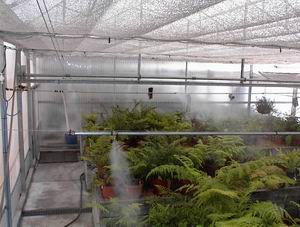
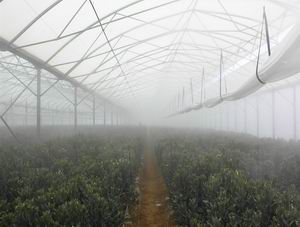
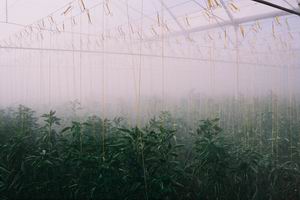
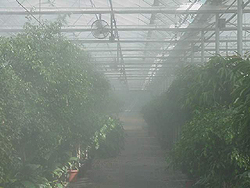
The fog provides the unique opportunity to visualize air flow patterns
in the greenhouse and assess the efficiency of vents and fans.
Remote temperature and humidity sensors provide precise feedback control
for the fogging system over a wide range of environmental conditions.
The system does not operate like a continuous 'wet blanket' but cycles
in response to preset humidity and/or temperature levels. The desired
climate can be prescribed over a wide range depending on ambient conditions.
The system has potential as a dispersal mechanism for insecticides
and plant nutrients. This will eliminate the need for labour intensive
hand spraying. Also, the insecticides can be injected from a remote
location with the assurance of even dispersal and minimal health hazard.
Similarly, dissolved nutrients can be aerially delivered and evenly
distributed to the crop. Simply turn off the ventilation while the
poison or food is being applied to avoid blowing it away.
The comfort of greenhouse workers will be greatly enhanced,. The evaporative
cooling results in 'air conditioned' comfort in the greenhouse without
making surfaces or bodies wet.
Potential
Drawbacks
So far we have seen that the Fogging System appears to be the answer
to a dream for the greenhouse operator. From the aspect of plant production
and quality there is no question that the fogging system will achieve
positive results. The elegance and simplicity of applying this concept
to greenhouse environment control requires no argument to explain.
However, there must be some negative aspects: there always are. The
question is, do the pros outweigh the cons enough to make it a commercially
viable proposition?
First of all, why hasn't someone thought of this before? In fact the
idea is not particularly new but technology has only recently caught
up with our desire to take advantage of it. Clean supplies of water,
the advent of efficient electric motors and pumps, economical piping
that won't break down in the sunlight and efficient, easily maintained
filter systems all combined to make reliable fogging a practical alternative
to other forms of environmental control.
A prime consideration in using the fogging system is the water supply.
A common problem among well and municipal supplies in North America
is a high dissolved mineral content. This could lead to scale deposits
and potential nozzle blockage. The system employs various scale inhibiting
treatment procedures to help keep mineral ions like calcium and magnesium
in solution.
However, these solids must come out of resolution when the water evaporates
and this could lead to a residue on the surface of the crop. In most
cases this is alleviated with appropriate ventilation and mixing of
the air to remove the "dust".
Mechanical components of other systems in the greenhouse such as vents
and fan motors may suffer from the elevated humidity.. It may be necessary
to adjust humidity levels below desired optimum levels for certain
periods.
In climates which experience large variations in day/night temperature,
some adjustment in operating procedures will be required to mitigate
problems of condensation. As the sun goes down in the late Summer
and Autumn months in northern temperate climates, the greenhouse structural
components will cool and condensation will occur.
This will occur despite the feedback control of the sensors since
the fogging system can only put water into the air not take it out.
It is possible to lessen this problem by automatically cycling the
humidity settings at times when condensation is a hazard.
Coupled with the above problems is that of mildew and associated fungal
diseases. It may be necessary to independently control these factors
at certain times of the year through a spray program. This, of course,
would add to the operating costs of fogging systems.
Regions which typically experience high ambient humidity levels will
benefit least from the use of greenhouse fogging systems. The principle
of operation requires that the desired greenhouse humidity level be
somewhat above ambient. In this sway, fullest advantage can be taken
of the humidity control and evaporative cooling aspects of the fogging
system.
Basically, the drawbacks in the application of the fogging system
will be those that do not permit the fullest use of its advantages.
Proper management will achieve positive results under most conditions.
The Fogging System is completely adaptable to a wide range of conditions
and applications. Therefore, I feel quite confident in its potential
to achieve the desired end….an economical and productive greenhouse
in a wide range of applications.
ENVIRONMIST’s
high pressure fogging systems are an effective tool to control the
humidity and temperature in the greenhouse environment. Typically
all growers have a problem with low humidity and high temperatures.
ENVIRONMIST addresses these problems by using high pressure fog flash
evaporating into the air.
Serious
problems occur when the humidity in the greenhouse environment drops
below 30% RH. Plants will suffer and typically slow or halt the growing
process.
ENVIRONMIST
fog systems for greenhouse environmental control provides the solution
to all of these problems. The fog system is installed in the house
with patented nozzles equally spaced within the house producing a
10 micron droplet. These droplets quickly evaporate without wetting
into the air to cool and humidify. University tests prove that ENVIRONMIST
can effectively increase production and quality for greenhouse growers.
Without
an ENVIRONMIST system greenhouses in arid conditions close down for
the summer months until ambient temperatures will reduce to an acceptable
level. ENVIRONMIST Fog in propagation and germination greenhouses
maintains a high humidity (over 90%) in the house for effective production.
Conventional
systems such as Pad & Fan do not provide the cooling required
or results are uneven. Large fans are required and incur huge energy
costs.
Temperature
reductions of up to 35°F (15°C) can be expected in many situations
around the world. Humidity control can be evenly controlled through
the house for even propagation and growth.
Computer
or analog control systems precisely control the humidity and temperature
to exacting levels thereby reducing energy costs. The computers can
integrate all the other greenhouse functions and systems such as boilers
and irrigation valves.
ENVIRONMIST
systems are custom made for each greenhouse and incorporate state
of the art flexible lines, high pressure pumps and installations materials.
Systems installed around the globe are every day giving the growers
the solution to temperature and humidity problems.