 |
 |
 |
 |
|
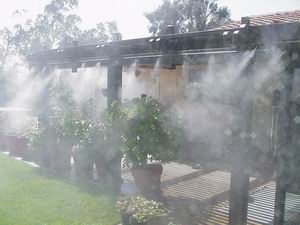
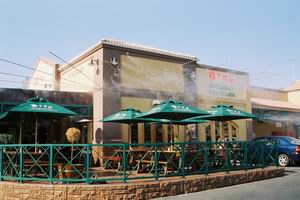
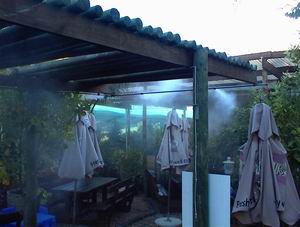
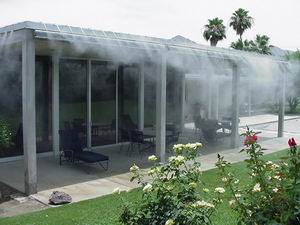
Being able to enjoy the sunshine no matter how hot it gets! Utilising high- pressure fog for outdoor cooling is a break through in 'air conditioning' the great outdoors .It is achieved by the evaporation of high - pressure fog without any wetting or residual moister. The EnvironMist System is typically installed around the area that is to be cooled, and then when the tiny droplets come into contact with dry hot air they evaporate and this drops the air temperature. Through using the EnvironMist system outside air can be cooled down by as much as 10 °C. All this is achieved with the running costs of less than 1/3 that of conventional air conditioning. The hotter and drier it is, the faster the fog evaporates, making EnvironMist's performance even more impressive.
Benefits
Applications
|
| A Brief Explanation
of Evaporative Cooling In our range of cooling equipment we have a wide selection of Evaporative Coolers which are suitable for cooling areas from 120ft² (11.1m²) to in excess of 2000ft² (186m²). These machines use a supply of water and, unlike air conditioners, do not have exhaust hoses or outside condenser boxes. They are different from air conditioners in that they provide cooled moist air rather than refrigerated dry air. On a warm summer day, if you were to put your arm in a bucket of warm water and pull it out, you would feel a slight chill. The cooling would not be due to the temperature of the water, but rather, the evaporation of water off your arm. Evaporative cooling is a very powerful, yet inexpensive method of cooling. In very dry climates, everything from residential homes to large buildings use evaporative cooling to reduce air temperature. Though widely used, the actual mechanics of how evaporative cooling systems operate are difficult to comprehend. With proper understanding of evaporative cooling, problems can be avoided, and the cooling ability of these systems can be increased. What is evaporative cooling? When trying to understand evaporative cooling, it may be best to think of air as a type of sponge. Like a sponge, as air comes into contact with water, it absorbs it. The amount of water absorbed depends largely on how much water is already in the air. After all, how easily you clean up a spill depends on how dry a sponge you are using. The term 'humidity' describes the level of water in the air. If the air holds 20% of its capacity, the humidity would be 20%. A humidity of 100% indicates that the air is holding all the moisture it can. The lower the humidity, the more water the air can hold, and the greater amount of evaporation that can take place. When describing the amount of moisture in the air, the term relative humidity is used because the sponginess of air changes relative to air temperature. The warmer the air, the more spongy it becomes and the more water it can hold. As a result, we must describe the level of humidity relative to the type of sponge we are talking about. Is it a 10°C sponge or an 27°C sponge? An 27°C sponge will hold more water at 50% humidity than a 10°C sponge. How is the Cooling Produced? In order to evaporate water, heat (energy) is required. In fact, to evaporate a gallon of water requires almost 8,700 Btu's of heat. Where does this heat come from? From whatever the water is in contact with as it evaporates. This could be a pavement, your body, a tree or from the air itself. As the heat is removed from an object, the temperature of that object is decreased. It is important to realise that the temperature of the water does not have a great effect upon the cooling produced through the evaporation. If you were to place a gallon of 10°C water on a warm pavement (32°C) it would produce 9000 Btu's of cooling. A gallon of 32°C water would produce 8700 Btu's of cooling, only a 3% difference. After all, if you were sprayed with water at either temperature on a hot day, you would feel much cooler. The key to getting the most out of an evaporative cooling system is to maximise the amount of air that comes into contact with the moisture added to the room/area. This makes sense because the best possible way to clean up a spill with a sponge is to go over it time and time again, flipping the sponge over and over, making sure that the dry sections of the sponge come into contact with the water. Some practical tips: Cold water does not significantly increase the cooling efficiency of an evaporative cooler. Evaporative coolers must only be used in areas, which have good natural ventilation or adequate mechanical air extraction units. EVAPORATIVE AIR COOLER TEMPERATURE DROP CHART. These charts show the approximate output temperature at the grill of an evaporative cooler given the ambient temperature and relative humidity % (RH) combination. The figures assume a minimum pad saturation of 80%. The first chart shows ºC (Centigrade) the second ºF (Fahrenheit). |
 |